
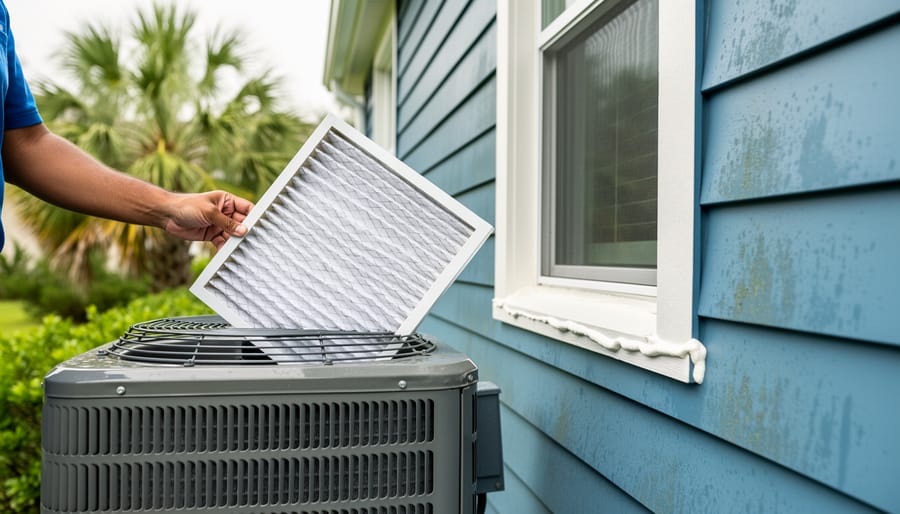
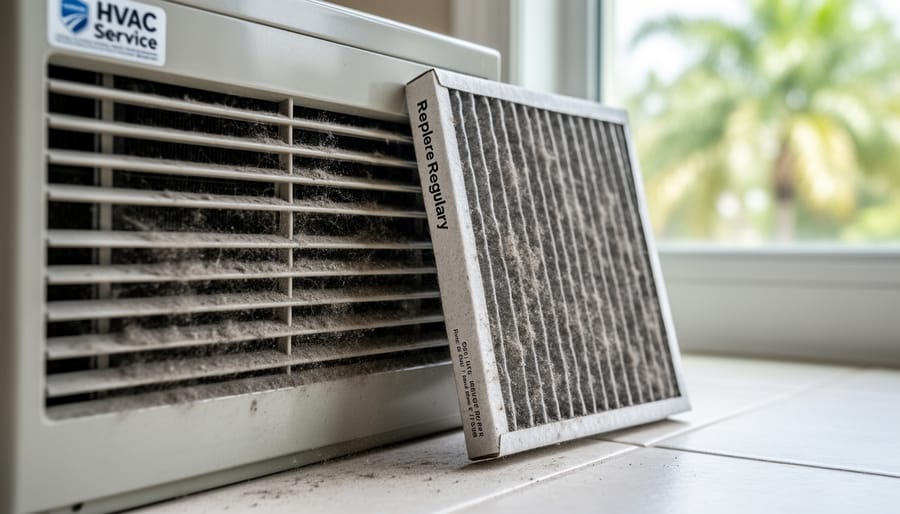
Inspect your air conditioning system monthly and replace filters every 30 to 60 days, because Florida’s relentless humidity and heat force HVAC units to work overtime. Professionals like Dryer Vent Clean Experts emphasize that moisture-related maintenance extends beyond cooling systems to every ventilation point in your home. Clean dryer vents quarterly to prevent lint buildup that combines with humid air to create fire hazards and mold growth.
Seal windows and doors against moisture intrusion using marine-grade caulk, which withstands tropical conditions better than standard products. Check weather stripping twice yearly, especially before hurricane season. Unlike Toronto’s freeze-thaw cycles that crack foundations, Florida homeowners battle constant water vapor that seeps through the smallest gaps.
Trim trees and shrubs at least 10 feet from your roof and exterior walls. Storm damage isn’t your only concern here. Overhanging vegetation traps moisture against siding and creates highways for termites, carpenter ants, and other pests that thrive in subtropical climates year-round.
Power wash your home’s exterior every six months to remove mildew, algae, and salt residue if you’re near the coast. That green or black discoloration isn’t just cosmetic. It’s organic growth eating away at paint and siding. Some homeowners now use smart home tracking systems to monitor humidity levels in real time, catching problems before visible damage appears.
Test your sump pump and drainage systems before rainy season hits. Florida receives over 50 inches of annual rainfall in many areas, and your property’s ability to shed water quickly determines whether you’re protecting an investment or funding constant repairs.
The Humidity Factor: Florida’s Biggest Home Enemy
Walk into a Florida home in July and you’ll understand within seconds why the state earns its nickname as the Sunshine State’s humidity capital. While Toronto homeowners worry about frozen pipes and ice dams, Florida properties wage a different battle against an enemy that never takes a winter break: relentless moisture in the air.
Florida’s average relative humidity hovers between 60 and 75 percent year-round, compared to Toronto’s 65 percent average that drops significantly during winter heating season. This constant moisture creates a perfect breeding ground for problems Toronto homeowners rarely face. Condensation forms on cold surfaces, water vapor seeps into wall cavities, and humidity fuels mold growth in attics, crawl spaces, and behind baseboards where you won’t spot it until damage is done.
Your HVAC system bears the brunt of this moisture assault. Air conditioners in Florida run nearly year-round, not just cooling air but constantly extracting humidity to maintain livable conditions. This non-stop operation means evaporator coils work overtime, condensate drain lines clog faster with algae growth, and filters trap more moisture-laden particles than their northern counterparts ever see.
Even appliances like dryers face humidity challenges. Lint that would stay relatively dry in Toronto’s climate becomes damp and sticky in Florida, clinging to vent walls and creating a compounding problem. The same moisture that makes your beach towels take forever to dry also prevents lint from flowing freely through your exhaust system, setting up conditions for restricted airflow and potential fire hazards.
The lesson here? Florida maintenance isn’t just more frequent than Toronto’s seasonal schedule. It requires a fundamentally different approach that treats humidity as an active, year-round threat rather than a summer inconvenience.
Your Dryer Vent is a Fire Hazard (Especially in Florida)
Signs Your Dryer Vent Needs Immediate Attention
Your dryer shouldn’t take two cycles to handle a normal load of towels. If it does, you’re looking at the first warning sign that something’s wrong with your vent system. Florida’s humidity makes this problem worse because moisture-laden air struggles to escape through already-restricted vents, creating a dangerous feedback loop.
Watch for these red flags:
- Clothes feel damp or hot at the end of a normal cycle
- The dryer itself is unusually hot to the touch during operation
- Your laundry room feels like a sauna while the dryer runs
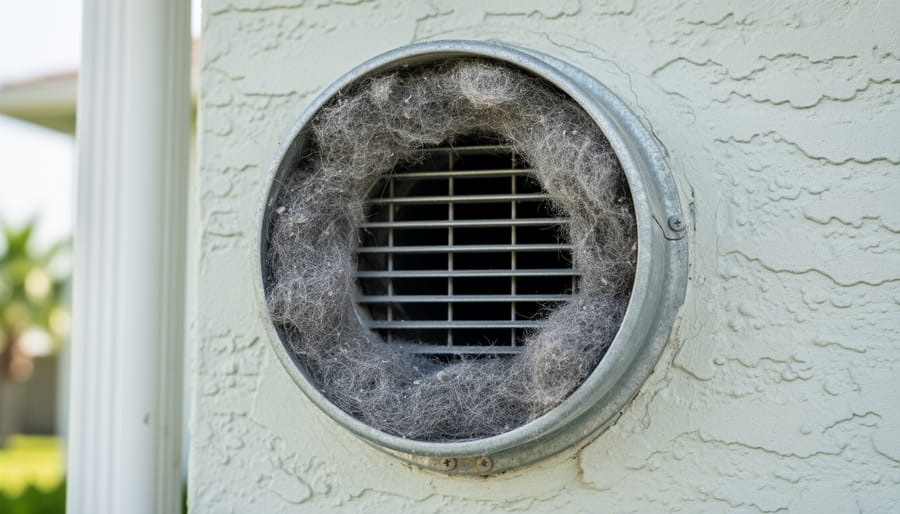
- Visible lint accumulation around the outside vent opening
- A burning smell when the machine is running
- The vent hood flap doesn’t open properly when the dryer operates
That burning smell isn’t something to ignore. It means lint has built up enough to start scorching against the dryer’s heating element. In Florida’s year-round heat, this creates serious fire risk because your dryer runs constantly rather than taking seasonal breaks like it might up north.
Check the external vent opening monthly. If you see lint clinging to the outside flap or notice the flap stays shut even when the dryer’s running, airflow is severely compromised. Most fire safety experts recommend you clean dryer vents twice yearly at minimum, but Florida’s humidity often demands quarterly attention. Don’t wait until your electric bill spikes or your dryer dies, both are expensive consequences of a problem that costs fifty bucks and an hour to fix.
The Right Way to Clean Your Florida Dryer Vent
Start by disconnecting your dryer and pulling it away from the wall. You’ll need a vacuum with a hose attachment, a dryer vent brush kit (available at any hardware store for around $15-30), and a screwdriver. The real work begins at the exterior vent opening.
Walk outside and locate where your dryer vents to the exterior. Remove the vent cover and use your brush to scrape out the accumulated lint. In Florida’s humidity, this lint often feels damp and compacted rather than fluffy like you’d find in drier climates. That moisture makes it stick to vent walls more aggressively.
Back inside, detach the vent duct from both the dryer and the wall. Feed your vent brush through the entire length of the ductwork, working it back and forth to dislodge buildup. Follow with the vacuum to pull out loosened debris. If your vent run exceeds 15 feet or has multiple bends, you’re fighting an uphill battle with DIY methods.
For Florida homes, clean your dryer vent every three to four months. Our humidity accelerates lint accumulation compared to the six-month interval recommended for drier climates. If you use your dryer daily or have a household of four or more, bump that up to every two months.
Professional cleaning costs between $90-$180 but includes inspection of the entire vent system, something most homeowners skip. Professionals can also identify crushed ducts, improper installations, or vents that terminate too close to the ground where Florida’s heavy rains create additional moisture problems.
If your vent run is longer than 25 feet, has more than two 90-degree turns, or you haven’t cleaned it in over a year, skip the DIY route and call a professional for 2026.
Seasonal Maintenance That Actually Matters in Florida
Forget spring cleaning and winterizing your pipes. In Florida, the seasons don’t signal leaf-raking and furnace checks, they dictate when hurricanes arrive, when afternoon thunderstorms flood your yard, and when you can finally paint that fence without the humidity wrecking the finish.
Instead of four seasons, think of Florida in three maintenance cycles: hurricane season (June through November), the rainy season that overlaps it (May through October), and the blessed dry season (November through April) when you can tackle outdoor projects without battling moisture at every turn.
Hurricane season demands your attention before the first storm forms. June is your deadline for trimming trees that could become projectiles, securing loose roof tiles, and testing your storm shutters. Check that your garage door can withstand high winds, it’s often the weakest link in your home’s envelope. Clear gutters and downspouts so they can handle the deluge when storms hit. Stock up on plywood, batteries, and supplies before everyone else panics.
During the rainy season, your focus shifts from preparation to vigilance. Walk your property after heavy rains to spot new drainage problems before they become foundation issues. Watch for standing water near your home, mosquitoes breed fast, and moisture seeping toward your foundation causes problems you’ll pay for later. This is when your dryer vent needs extra attention too; the humidity makes lint stick and clump more stubbornly.
| Season | Priority Tasks | Why It Matters |
|---|---|---|
| Hurricane (Jun-Nov) | Secure shutters, trim trees, test generator | Prevent catastrophic storm damage |
| Rainy (May-Oct) | Monitor drainage, check for leaks, pest control | Humidity invites mold and critters |
| Dry (Nov-Apr) | Paint, seal, repair wood, deep clean exterior | Low humidity means better results |
The dry season is your window for everything else. Paint adheres properly when humidity drops below 50%. Pressure wash your home’s exterior without worrying about trapped moisture causing mildew. Seal your driveway, repair wooden structures, and tackle any outdoor projects you’ve been postponing. In Toronto, you’d wait for snow to melt. Here, you wait for the air to dry out.
The Three Systems You Can’t Ignore
HVAC: Your Most Expensive Friend
Your air conditioner doesn’t just cool your Florida home, it runs nearly year-round, working harder than any HVAC system in Toronto ever will. While northerners fire up their AC a few months annually, yours operates 10-12 months straight, fighting 90-degree heat and 80% humidity simultaneously. This relentless workload turns your HVAC into both your best friend and biggest expense.
The numbers tell the story: a well-maintained Florida AC lasts 10-15 years, but neglect can cut that to 7 years. Replacement costs run $5,000-$12,000 depending on your home’s size. Regular maintenance, changing filters monthly during peak season, annual professional servicing before summer hits, and keeping outdoor units clear of debris, extends equipment life and slashes energy bills by up to 25%.
Here’s what catches Florida homeowners off-guard: humidity makes your system work double duty. It’s not just cooling air; it’s pulling moisture out constantly. When filters clog or coils get dirty, efficiency plummets. Your unit runs longer cycles to achieve the same comfort level, burning more electricity and wearing components faster.
Schedule professional maintenance in early spring, before the brutal June-September stretch. Technicians check refrigerant levels, clean coils, test capacitors, and catch minor issues before they become catastrophic failures during a heat wave. Skipping this $100-$200 annual service virtually guarantees a $1,500+ emergency repair when you can least afford downtime.
Roofing in the Sunshine State
Florida’s relentless sun does more damage to your roof in five years than a Toronto roof sees in ten. UV radiation doesn’t just fade shingles, it breaks down the asphalt binders that hold them together, creating brittle spots that crack during the next thunderstorm. Add in afternoon downpours that can drop two inches of rain in an hour, and you’ve got a roofing environment that accelerates aging exponentially.
Inspect your roof twice a year minimum, ideally before and after hurricane season. Look for curling shingle edges, granule loss in gutters, and any discoloration suggesting algae growth. That black streaking you see on neighborhood roofs isn’t dirt, it’s algae feeding on limestone filler in shingles, and it thrives in Florida’s humidity while shortening roof life by years.
Material choice matters more here than up north. Clay and concrete tiles withstand UV punishment better than asphalt but cost significantly more upfront. Metal roofing reflects heat and resists wind damage, though it requires proper installation to prevent noise issues during rainstorms. Whatever you choose, ventilation is non-negotiable. Trapped attic heat in Florida reaches 150 degrees, cooking your roof from below while the sun attacks from above.
After any tropical storm, even minor ones, walk your property and scan for lifted shingles or exposed nail heads. Small damage spreads fast in this climate. A missing shingle today becomes water damage in your ceiling next month.
Drainage and Gutters: Fighting Daily Downpours
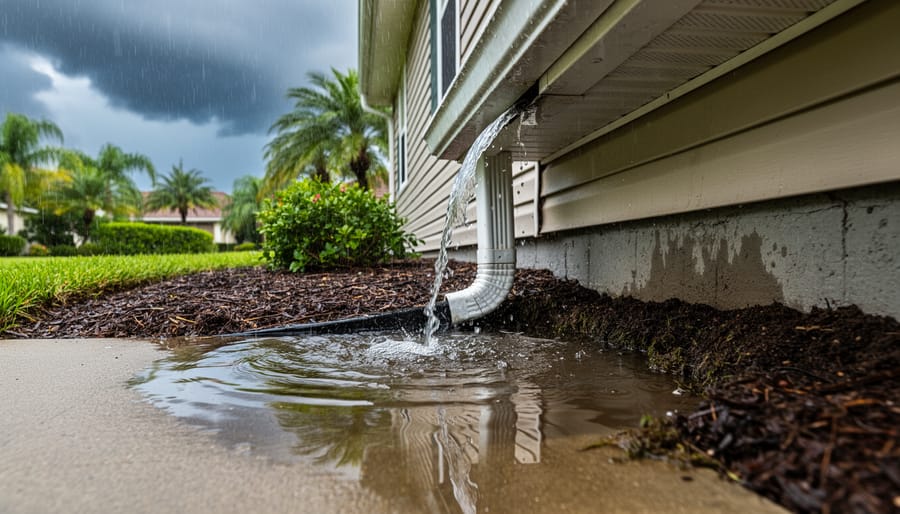
Florida’s rainy season brings afternoon downpours that dump inches of rain in minutes, not hours. Your gutters and drainage system need to handle this volume or you’ll pay for it with foundation cracks and mosquito breeding grounds around your home.
Check gutters monthly during rainy season (June through September). Palm fronds, oak leaves, and the fine debris from tropical plants clog faster than northern vegetation. Standing water in clogged gutters attracts mosquitoes within days and creates perfect conditions for termites seeking moisture.
Your downspouts should direct water at least six feet from your foundation. Florida’s sandy soil drains quickly, but only if water moves away from your home first. Watch for pooling near your foundation after heavy rain. If you see standing water an hour after a storm, you need better grading or French drains.
Clean gutters after every major storm. Hurricane season throws everything into your system, and one clogged corner redirects hundreds of gallons against your exterior walls. Install gutter guards designed for heavy rainfall, not the cheap mesh that clogs with Florida’s sticky pollen and seed pods.
What Toronto Does Better (And What Florida Does Right)
Toronto homeowners understand preventive maintenance in ways Florida residents often don’t. When you sell a Toronto home buyers expect detailed maintenance records because winter forces accountability. Furnace inspections aren’t optional when January temperatures hit minus twenty. That discipline translates well to Florida property ownership, where consequences of neglect simply manifest differently.
The Toronto housing crisis has pushed many homeowners toward Florida’s more affordable market, bringing northern maintenance habits south. They arrive knowing how to navigate neighborhoods and research local conditions before buying. That research mindset serves them well when learning about hurricane shutters and drainage systems.
- Toronto’s harsh winters create a culture of rigorous seasonal maintenance and inspection schedules.
- Florida’s year-round accessibility eliminates weather delays for exterior repairs and inspections.
- Toronto homeowners develop strong relationships with contractors due to repeated seasonal needs.
- Florida’s competitive service market keeps maintenance costs lower than many northern markets.
- Toronto’s short construction season inflates prices and creates contractor shortages during peak times.
- Florida’s humidity accelerates deterioration of materials that would last decades in dry climates.
- Toronto’s freeze-thaw cycles damage foundations and driveways, requiring expensive repairs.
- Florida’s hurricane season demands specialized preparation unfamiliar to northern homeowners.
Florida gets outdoor living right in ways Toronto can’t match. While northerners huddle indoors half the year, Florida homeowners maintain landscapes and exterior features monthly. This constant engagement with outdoor spaces means problems get spotted faster. Toronto homeowners might notice a roof leak only after spring thaw, but Florida residents see water stains immediately during weekly pool maintenance.
What surprises transplants most is how home décor preferences shift between climates. Toronto basements become finished living spaces worth maintaining, while Florida homes avoid below-grade rooms entirely. Both approaches make sense for their environments, teaching homeowners that good maintenance means understanding what your specific climate demands rather than applying universal rules.
Your Florida home isn’t going to maintain itself the way a Toronto property might. The climate won’t give you that seasonal break where things freeze solid and problems pause until spring. Instead, you’re dealing with year-round humidity, relentless sun, and weather patterns that demand constant vigilance.
The homeowners who thrive here understand that maintenance isn’t about reacting to problems, it’s about staying ahead of them. Your HVAC system needs attention before it fails during August’s peak heat. Your roof requires inspection before hurricane season, not after. And yes, your dryer vent needs cleaning more frequently than you think, because lint plus humidity equals a fire risk you can’t afford to ignore.
Think of Florida home maintenance as a different sport entirely. The rulebook changed when you crossed state lines. What worked in cold climates won’t cut it here, and that’s okay. Embrace the rhythm of rainy seasons and dry seasons instead of traditional fall prep and spring cleaning. Check your drainage systems after every major storm. Make peace with the fact that mold prevention is a lifestyle, not a project.
The good news? Once you adjust your mindset and build these habits into your routine, Florida homeownership becomes manageable. Your home will reward the attention with longevity, efficiency, and fewer expensive emergencies down the line.